Showing posts with label lecture. Show all posts

Wednesday, November 6, 2013

Understanding Broadway Augmented

Image courtesy of the Sacramento Metropolitan Arts Commission
Beginning in the spring of 2014 Broadway street in Sacramento will undergo a radical transformation imperceptible to the naked eye. Utilizing augmented reality technology the Broadway corridor will feature ten site specific virtual public artworks created by local, regional and national artists. Titled Broadway Augmented, the project combines computer generated environments seamlessly merged with the real world. Funded in part by the National Endowment for the Arts, the project proposes to lay the groundwork for permanent works of public art for this diverse neighborhood.

Learn more about Broadway Augmented by joining us at 7pm on Thursday, November 14th at CCAS. The evening will begin with introductions by Shelly Willis, followed by a discussion moderated by Rachel Clarke, featuring participating artists Jose Carlos Casado (NY), Sabrina Ratte (Montreal), and Michael Rees (NJ).  For those unable to attend be sure to visit the Sacramento Metropolitan Arts Commission’s website, or read their press release below, for more details.


Tuesday, March 27, 2012

Hanging in the Balance at CCAS Through April 1st


This is the last week of our exhibition Hanging in the Balance: Ten Emerging Chinese Artists. The Sacramento Bee's Victoria Dalkey described the various works in the show as alternately "hilarious," (Jia Zhixing's photos) "quirky and unsettling," (Chen Wei's drawings--see an example below) or "hypnotically beautiful" (Zhifei Yang's film Day Dreams). Read Dalkey's full review here, and don't miss your chance to see this rare show of international art.

To enhance your experience of the exhibition, you have the opportunity to attend a special lecture this Thursday, March 29 at 7pm. Titled "New Art from New China," the lecture will be given by Katharine Burnett, Associate Professor of Art History at UC Davis.

The show closes this Sunday, April 1st, so be sure to come and visit us this week!

Tuesday, April 19, 2011

Gay Outlaw: The Velocity of Ideas

(Image from the Sacramento News and Review)

The current exhibition at CCAS is Gay Outlaw: The Velocity of Ideas, a solo show of sculpture and a few small works on paper by San Francisco artist Gay Outlaw. Primarily regarded as a conceptual sculptor with a growing national reputation, Gay Outlaw works as an investigator of physicality, perception, memory, and materials. Her work revolves around combining inherent contradictions: sculptures that seem to be constructed of voids; photographs of false surfaces transformed into solid objects; images of holes, reversed, and cast in bronze and glass.

The show opened on April 5, and on Second Saturday, April 9 CCAS premiered a 30 minute video of a conversation between Outlaw and exhibition curator Chris Daubert.
A highlight from the video is up on our YouTube channel and may be viewed below:


Daubert also wrote the catalog for the exhibition, which is available for purchase at CCAS for $14.95 ($9.95 for members). An excerpt from the catalog is available online here.

The show has been the talk of the town recently, with mentions in the Sacramento News & Review, Midtown Monthly, the Sacramento Bee's Friday Ticket, the Sacramento Convention and Visitors Bureau website, Examiner.com and even the Newton Booth Neighborhood Blog. So what are you waiting for? Come and see for yourself what all the fuss is about!

As always the gallery is open 12-5, 6 days a week (Tue-Sun excepting Easter Sunday, the 24th) and the show is up through May 15.
The artist will give a lecture ($5 entrance, free for members and students) at 3pm on May 14, and there will be a closing reception that evening from 6-9pm.

SN&R's Shoka described the show as "brain-explodingly good"--you don't want to miss this!

Wednesday, March 16, 2011

Enid Baxter Blader's Lecture


Last Saturday Enid Baxter Blader gave a lecture on her paintings and film currently on view at CCAS. If you missed it, you can download the lecture audio here.
Blader started the lecture with a discussion of her paintings. Having started her artistic practice as a child with a passionate love of painting, a discouraging painting fellowship at Yale in her early twenties caused Blader to rethink her artistic identity. At the fellowship there was pressure to use thick paint, whereas Blader has more of an affinity for lots of thin layers and washes.
She ended up discovering digital film editing and finding that it "wove things together," allowing her to combine several of her interests--including writing and making music--into one practice. Meanwhile, she "kept painting secretly."
This is Blader's first show since she decided to stop showing in commercial galleries, and she expressed relief at the lack of stress when showing at a non-profit space.
As for the most frequently asked question in the gallery--what's the deal with the canola oil paint?--Blader explained that she developed an allergy to turpentine early in her painting career and thus prefers to use canola oil paint, which is water soluble.
An audience member asked about the connection between her film "THE ORD" and the paintings on display and Blader pointed to the murals she discovered at Fort Ord which were, like her paintings, "constructed to affect mood," as well as the respective "landscapes" of the works.
Blader discussed the circumstances surrounding the making of "THE ORD" in detail but you'll have to listen to the full lecture if you want to hear all the juicy details. She was even summoned by the Department of Defense to give a briefing on her work! Suffice to say Blader learned a great deal about the military through this project and she tells lots of great stories related to it.
Download the full lecture to hear more technical details about Blader's painting and film techniques, the ten things Blader says she learned at art school, an interesting description of making websites from hand-painted graphics and much more.

Tuesday, February 15, 2011

Gretchen Skogerson's Lecture

The video footage of Gretchen Skogeron's lecture is now up on our YouTube channel. All five parts are below for your viewing pleasure.
In his introduction, Youngsuk Suh emphasized the importance of "emptiness" to Skogerson's work, particularly her more recent projects documenting industrial landscapes at night. Then Skogerson took over, starting her lecture with an overview of her earlier work, beginning with her student days. Her first video pieces centered on the body and had some roots in feminism, which Skogerson attributed somewhat to the masculine and tech-based environment she was immersed in as part of the small electronic arts department at a large engineering school.
She then described her elaborate thesis installation, which she said made her realize she wanted her work to be simpler. She also spoke about a piece that stemmed from a personal ad she left in the Village Voice and the resulting messages on her answering machine.
Another intriguing piece was a collaboration called "Mirror, Mirror" consisting of a mirror that would say "psst!" to passers-by and then, when they leaned in close, it would tell them a secret. The "secrets" were also gleaned from a solicitation in the Village Voice.
This brought us to DRIVE-THRU, which came from Skogerson's "being in love with" the nighttime devastated industrialism in Miami. The piece was selected for the Whitney Biennial. For the Whitney's satellite exhibition at the Park Avenue Armory, Skogerson worked with an industrial sign company to recreate five of the signs from her video. Skogerson showed a striking image of the Armory with the signs installed that had been printed in the New York Times.
Next Skogerson gave an overview of her residency at Pittsburgh's Mattress Factory and other recent projects, all of which have had something of a focus on light as a material for art-making. Skogerson pointed out that light's potential as a material is easy to ignore because it is so ubiquitous in our lives, but that it can nonetheless be a powerful tool.
The lecture concluded with a viewing of Skogerson's latest work, Night Parking, another piece devoted to industrial spaces at night, and a thoughtful question-and-answer session.
For all the details and a look at some of the pieces Skogerson discussed, watch the lecture in full below:


Wednesday, January 26, 2011

Behind the Curtain


"Minimalism in the mundane, elegance in the shattered, and light in the dark."
-Nathan Lee via the Whitney Museum of American Art

If you've come into the gallery lately, you might have wondered: "What's behind the black curtain?" or "Where are those strange noises coming from?" The answer to both is Gretchen Skogerson's video piece DRIVE THRU. Described by the artist as "a landscape of incomplete signs," the piece depicts storm-ravaged fluorescent signage in Miami in the aftermath of Hurricane Ivan.
Betraying the striking similarities between this piece's underlying issues and those of Christina Seely's Lux, also currently on display at CCAS, Chris Stults of the Wexner Center for the Arts writes of DRIVE THRU, "What chance does light have against the darkness? The history of illumination is a story of miracles conjured to stave off the devouring night. As if at war with darkness, the modern metropolis has conquered the night and obliterated the sky." Yet the remnants of signs and streaks of fluorescent lighting in Skogerson's piece do not "obliterate" the black night surrounding them, but rather "engage in a dialogue" with the darkness.
Some of Skogerson's shots in the roughly twenty minute video are abstract light compositions--drawing comparisons to Dan Flavin--and some are more representational, incorporating passing cars and shadowy human figures. They all, however, point subtly to devastation, whether that of Miami post-Ivan or that of the earth via consumerism and energy usage. Writes Stults, "their form has become their content," and indeed, these sad, empty signs end up carrying deep meaning thanks to Skogerson's framing and her mix of ambient and recorded noises in the soundtrack. They also, surprisingly enough, become objects of beauty--"accidental works of art" barely noticed along the side of the road.
But Gretchen Skogerson noticed them, and now we invite you to notice them too. Come and see some or all of DRIVE THRU at CCAS, and then come hear Skogerson's lecture on February 10th at 7pm to learn more about this enigmatic piece.

Wednesday, January 19, 2011

Lecture Highlights

Missed Christina Seely's lecture? Can't decide if it's worth it to sit down and listen to the mp3? Here are some highlights to spark your interest.
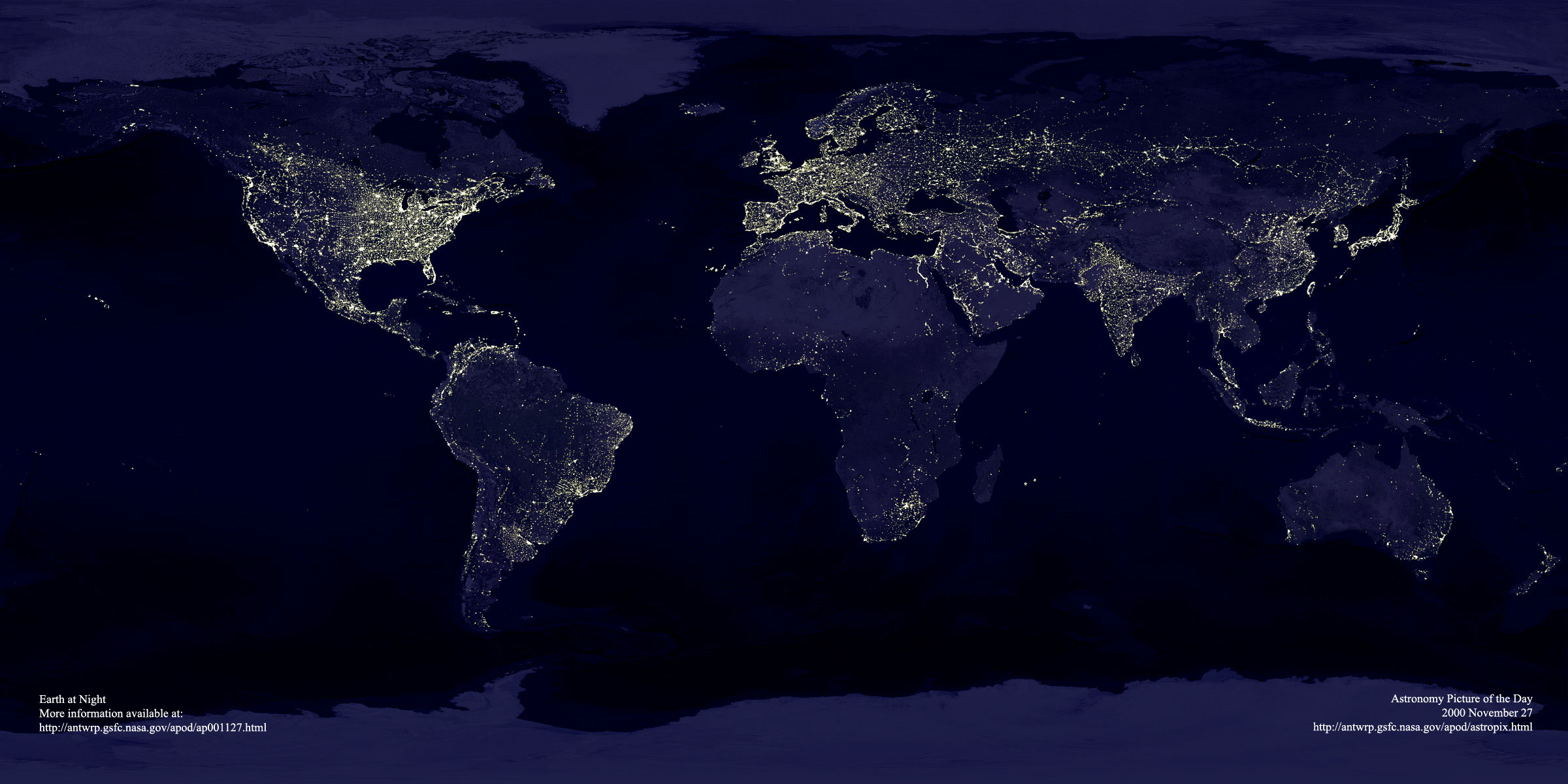
Seely started her lecture by discussing the NASA photo that inspired her project, saying: "About 5 years ago I became kind of obsessed with this map, really intrigued by it and interested in it…the information on it is unique in that it’s us--in the form of light." She went on to point out that though the concentration of light in the US, Western Europe and Japan (the three regions on which her project is focused) indicate the creation by those regions of half the world's CO2 and consumption of two-thirds of the world's resources, it is also, indisputably, a beautiful image.
This is partly because "since the dawn of electricity, man-made light has represented hope and ingenuity and romance and progress and basically fundamentally positive and hopeful things." Speaking of the history of man's use of electricity, Seely used a photograph of the 1904 St. Louis World's Fair and a small-town newspaper description of the wonder of streetlights, demonstrating some of the historical research behind her project.
Having laid the groundwork, Seely moved on to discuss the details of Lux, which she shot using an old analog camera complete with "dark cloth" over her head and exposure times of 1-4 hours. Utilizing a somewhat archaic form of photography to capture the effects of modern technology is part of the "tension" and "back-and-forth" to which Seely returned at many points in the lecture and sees as fundamental to her project.
Viewers might be interested to learn that there is absolutely no extra lighting or daylight involved in her images and that they are lit by the cities' ambient light and moon/starlight alone.
Seely spent the last part of her lecture discussing individual images in the Lux project, but you'll have to listen to the full lecture to hear her interesting and sometimes hilarious anecdotes about her adventures in shooting.
As part of her efforts to get viewers to think about these metropolises in different ways, Seely avoids identifying which photo is of which city and including iconic buildings or monuments too prominently in her images. For instance, she shot New York from Hoboken, New Jersey instead of using the iconic postcard shot that the view from Brooklyn provides.
See if you can spot Edinburgh Castle, Brussels' Justice Palace, Berlin's Potsdamer Platz, St. Louis' arch or D.C.'s Capitol Building. All are somewhat visible but not obvious in Seely's photographs.
Other interesting points to note are the streaks of planes landing at Newark airport in the New York image, the moon going in and out of clouds in Paris, a Christmas star in Phoenix, the streak of a passing ferry in Seattle and a graveyard in Yokohama City.
While only 10 of Christina's 45 Lux photographs are on display at CCAS, you can get a sense of the others on her website.
The final audience questioner made the point that for all that the project draws attention to energy use and man's effect on the planet, in Seely's beautiful photographs "it doesn’t look like something you would want to turn off." It a tension that Seely acknowledges and welcomes.
There are many more insights into the images and Seely's work in general to be gained from listening to the lecture, so be sure to check it out if you want to know more. And of course, come down and see the show in person at CCAS!

Saturday, January 15, 2011

Christina Seely's Lecture

Did you miss Christina Seely's lecture on Thursday? No problem! Lucky for you, we have an mp3 of the lecture. Click here to listen to this wonderful lecture where Christina Seely discusses her Lux series in depth and tells about her other collaborative project Civil Twilight.


Wednesday, January 12, 2011

Now Open on Wednesdays+Christina Seely's Lecture

Starting today, we are expanding our hours to include Wednesdays from 12-5. Come by and see us!

And don't forget, photographer Christina Seely will be lecturing at CCAS tomorrow, Thursday January 13th, at 7pm. The lecture is free to current CCAS members and students and general admission is $5.

Seely's current show at CCAS, Lux, consists of nighttime photographs of some of the world's largest metropolises, demonstrating the vast amount of artificial light emitted by large human settlements. Based on a NASA map of the night earth (see it here), Lux focuses on cities in the United States, Western Europe, and Japan.

Writes Seely, "For most of human history, man-made light has signified hope and progress within local and global arenas. In this project, light also paradoxically denotes regression or transgression--an index of the complex negative human impacts on the health and future of the planet."

Come to the lecture tomorrow night at 7pm to hear more about this intriguing project.